

I am trying to make a comprehensive collection of some state-of-the-art resources for machine learning, especially on deep learning. This page will be updated with a schedule, and more useful information with links (including papers, codes,or just ideas,etc) are expected.
1. A collection of classic deep learning papers that are worth reading.
Table of Contents (Link for more details and free access)
- Book / Survey / Review
- Theory / Distillation
- Optimization / Regularization
- Network Models
- Image
- Caption
- Video / Human Activity
- Word Embedding
- Machine Translation / QnA
- Speech / Etc.
- RL / Robotics
- Unsupervised
- Hardware / Software
- New Papers Worth Reading
- Classic Papers
- Distinguished Researchers
2. The following homepages benefits a lot for those who are interested in ML with a simple and direct problem formulation.
- Dmitry Efimov ‘s Homepage [Link]
3. What-AI-Can-Do-For-You. [Link]
4. Five Free Courses for Getting Started in Artificial Intelligence [Link]
——By Matthew Mayo, KDnuggets.
4.1. Intro to AI (UC Berkeley)
This could be considered the premier, pioneering, online-oriented, open-access university level AI course in existence.
Not everything is available to non UC Berkeley students (homework assignments and autograding), but the vast majority of materials are openly accessible. These materials are complete and well-organized, and include the following:
- A sample course schedule from Spring 2014
- Complete sets of Lecture Slides and Videos
- Interface for Electronic Homework Assignments
- Section Handouts
- Specs for the Pacman Projects
- Source files and PDFs of past Berkeley CS188 exams
- Form to apply for edX hosted autograders for homeworks and projects (and more)
- Contact information
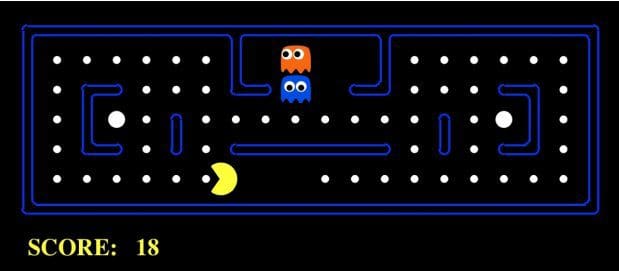
While mentioned that the homework assignments are not public, a series of progressing Pacman projects are, which cover search, reinforcement learning, classification, and beyond.
Led by professors Dan Klein and Pieter Abbeel, the lectures, videos, exams, and other materials date way back to 2014; however, it should come as no surprise that what you would learn in this course would in no way be outdated. Having consumed much of this course material several years ago myself, you can undoubtedly gain a competent overview of foundational AI topics here, including both theory and practice.
4.2. Artificial Intelligence: Principles and Techniques (Stanford)
This open offering from Stanford has this to say on its website:
What is this course about? What do web search, speech recognition, face recognition, machine translation, autonomous driving, and automatic scheduling have in common? These are all complex real-world problems, and the goal of artificial intelligence (AI) is to tackle these with rigorous mathematical tools. In this course, you will learn the foundational principles that drive these applications and practice implementing some of these systems.
Drawing from some of the most esteemed texts in the area (Russell & Norvig; Koller & Friedman; Hastie, Tibshirani & Friedman; Sutton & Barto), this collection of materials includes notes, slides, assignments, exams, and projects (including solutions). You will find overlap with the above Berkeley course, but the diversity of openly-available homework is likely better here, and includes such projects as:
- Sentiment classification
- Blackjack
- Pac-Man
- Scheduling
- Car tracking
- Language and logic
It is easy to assume that some combination of these first 2 course materials would provide a substantial introductory artificial intelligence education. Also, given that at least a few of the texts used in the Stanford course are (legitimately) freely available online, a near-immersive experience is possible.
This is David Silver’s renowned reinforcement learning course from University College London. The material is concise, consisting of both lecture videos and corresponding slides, the combination of which is packed with information.
4.4. Deep Reinforcement Learning (UC Berkeley)
Taught by Sergey Levine, John Schulman, and Chelsea Finn, this course is another take on reinforcement learning. The course is presently ongoing, with new lectures being streamed live as they happen, and available afterward as well.
It’s worth mentioning again that this course is ongoing, and so you will have to pace yourself alongside the class as it unfolds, since next week’s lecture materials are not yet available 🙂
4.5. Deep Learning for Self-Driving Cars (MIT)
This course has been making a splash online since going live, an MIT course on self-driving cars led by Lex Fridman. Like the previous course, this is also presently ongoing.

As deep learning continues its transition from research to real world tool, it’s interesting to see these deep learning specialized application courses pop up at distinguished universities all around. Also, withUdacity’s self-driving car nanodegree recently announced, the combination of these 2 white hot buzzword technologies into course material is a no-brainer. And that’s not a veiled shot: these are very symbiotic technologies, representing a de facto technological marriage of necessity.
Back to the course, it contains video lectures and a healthy dose of related materials, from tried and tested introductory Python and deep learning tutorials to historical autonomous vehicle information.
Both DeepTesla and DeepTraffic simulators are leaned on, and a number of guest talks are scheduled for later in the semester. Interestingly, the public (non-MIT students) can even register for an account on the site.
 M. Li's Blog